
The best native proxy client for iOS, iPadOS, and tvOS.
A native, zero-dependency proxy client built entirely in Swift. No Electron. No WebView. No sing-box wrapper. Pure protocol implementation from the ground up.

Most iOS proxy clients wrap third party components in a Go/C++ bridge. Anywhere takes a different approach — every protocol, every transport, the QUIC stack, and the entire packet tunnel are implemented natively in Swift and C. The result is a smaller binary, lower memory usage, tighter system integration, and no bridging overhead. The difference is measurable:
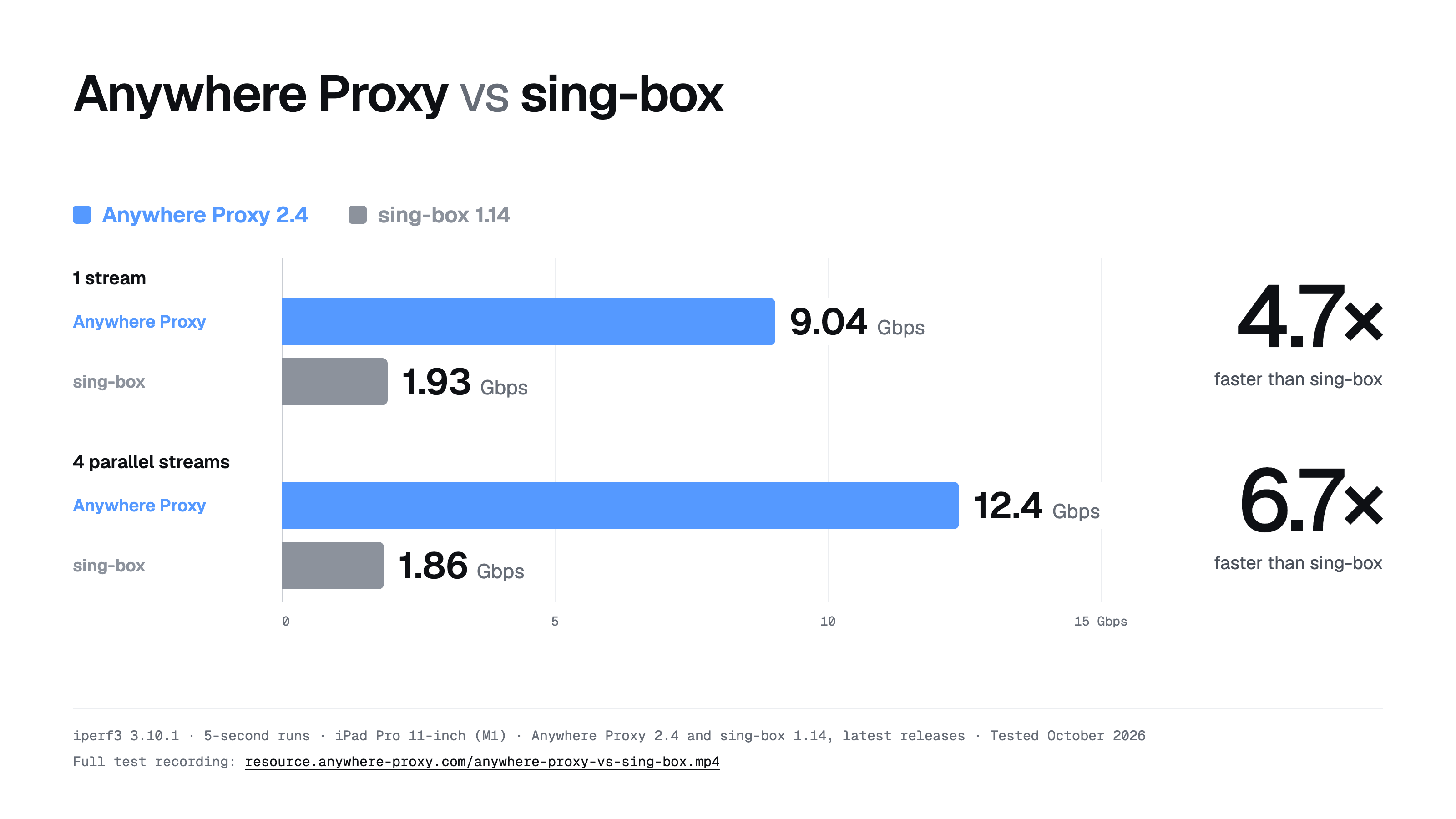
Measured with iperf3 3.10.1 on an iPad Pro 11-inch (M1) in 5-second runs, Anywhere Proxy 2.4 sustains 9.04 Gbps on a single stream and 12.4 Gbps across four parallel streams, against 1.93 Gbps and 1.86 Gbps for sing-box 1.14 — 4.7× and 6.7× faster respectively. Both were the latest releases at the time of testing.
- Native core — Swift 6 with strict concurrency, the native AnywhereIP TCP/IP stack, the native AnywhereQUIC engine, and vendored C for BLAKE2 and BLAKE3. No Go or C++ core, no bridging layer, no third-party networking engines. A single codebase builds the iOS, iPadOS, tvOS, and watchOS apps, the packet tunnel, and the Control Center controls.
- Native TLS stack — TLS 1.2 and 1.3, client and server, implemented in Swift. Browser-exact ClientHello fingerprints for Chrome, Firefox, Safari, and Edge; Encrypted Client Hello from an inline configuration or from DNS HTTPS records; hybrid X25519 and ML-KEM key shares. The same stack terminates TLS for MITM and provides the handshake primitives for Reality.
- Native QUIC stack — AnywhereQUIC implemented in Swift, with BBR, CUBIC, and Brutal congestion control, connection migration, DATAGRAM frames, session resumption, and pluggable packet obfuscation. One engine serves Hysteria2, Nowhere, and XHTTP over HTTP/3.
- Multi-stage routing — a five-tier matcher built from domain-suffix tries, keyword automata, and CIDR tries classifies each destination at DNS time through Fake-IP, at connect time before the TCP handshake is accepted, and again mid-connection from the sniffed TLS SNI. Bundled service, ad-block, and country-bypass rule sets are complemented by importable and subscribable
.arrsrule sets. - Built-in MITM — HTTPS is terminated with a generated root CA. HTTP/1.1 and HTTP/2 traffic is rewritten by declarative rules or JavaScript, HTTP/2 clients are bridged to HTTP/1.1 upstreams, and script-initiated HTTP requests are dialled through the tunnel's own routing.
- Modules — a single
.amodfile bundles routing and MITM rule sets for a service into one importable, subscribable unit with its own switch, synced as one record so it is never seen half-updated. - Purify and DNS — a QUIC policy that fails HTTP/3 fast so that routing and MITM act on HTTP/2, WebRTC and UDP blocking, DNS-leak prevention, and independent plain or DoH resolvers for proxy servers, local requests, subscriptions, ECH, and fallback.
- Platform integration — a native Apple TV app, an Apple Watch companion, Control Center toggles for VPN and mode, and iCloud sync through CloudKit.
- Engineered for the extension budget — global buffer ledgers, connection caps, and pressure throttling keep the packet tunnel within the Network Extension memory limit.
| Protocol | Highlights |
|---|---|
| Nowhere | TCP and UDP forwarding over TLS 1.3 or QUIC · Morph masking · dedicated TLS flows · QUIC streams and QUIC DATAGRAM |
| VLESS | VLESS Encryption · XTLS-RPRX-Vision · Reality with browser fingerprints · WebSocket, HTTPUpgrade, gRPC, and XHTTP transports · XHTTP over HTTP/1.1, HTTP/2, and HTTP/3 with upload/download detach and XMUX · XUDP |
| Hysteria2 | Brutal congestion control · Salamander and Gecko obfuscation · UDP over QUIC DATAGRAM |
| Sudoku | Payload encoded as Sudoku-grid hints with per-direction ASCII or entropy layouts and randomly selected custom tables · KIP X25519 handshake with session rekeying · HTTP masquerade in legacy, stream, poll, and WebSocket modes · pure-downlink mode · native multiplexing |
| Trojan | Kept for subscription compatibility |
| AnyTLS | Kept for subscription compatibility |
| Shadowsocks | Shadowsocks · Shadowsocks 2022 |
| SOCKS5 | Standard SOCKS5 Proxy · UDP ASSOCIATE |
| RFC | Standard CONNECT Proxy · HTTP/1.1 or HTTP/2 |
flowchart TB
    subgraph APP["Anywhere app · iOS / iPadOS / tvOS · watchOS · Control Center"]
        UI["SwiftUI / UIKit"] --> STORES["Stores<br/>SwiftData · CloudKit sync"]
        STORES --> OPS["Operations<br/>compile routing & MITM payloads"]
    end

    OPS -- "provider messages · App Group files · Darwin notifications" --> PTP
    PTP -. "stats · requests · logs" .-> UI

    subgraph NE["Network Extension"]
        PTP["PacketTunnelProvider"] --> STACK["TunnelStack<br/>AnywhereIP"]
        STACK -- "DNS" --> DNS["DNS interceptor<br/>Fake-IP pool"]
        STACK -- "TCP" --> TCP["TCPConnection<br/>SNI / HTTP sniffing"]
        STACK -- "UDP" --> UDP["UDPPlane<br/>QUIC · WebRTC policy"]
        DNS & TCP & UDP --> ROUTER["ConnectionRouter<br/>five-tier rule matcher"]
        ROUTER -- "reject" --> DROP(("drop"))
        ROUTER -- "direct" --> DIRECT["Direct dial"]
        ROUTER -- "proxy / chain" --> CLIENT["ProxyClient<br/>chain hops"]
        TCP -. "matched host" .-> MITM["MITM session<br/>TLS server · rewrite · JavaScript"]
        MITM -. "re-routed upstream" .-> ROUTER
    end

    subgraph PROTO["Shared protocol stack"]
        CLIENT --> OUT["Nowhere · VLESS · Hysteria2 · Sudoku<br/>Trojan · AnyTLS · Shadowsocks · SOCKS5 · RFC"]
        OUT --> TLS["TLS 1.2 / 1.3 · Reality · ECH"]
        OUT --> QUIC["QUIC · AnywhereQUIC<br/>BBR · Brutal · DATAGRAM"]
    end

    TLS & QUIC --> SERVER(("Proxy server"))
    DIRECT --> INTERNET(("Internet"))
    SERVER --> INTERNET
- Routing Rule System — developer guide to authoring routing rule sets and the
.arrsimport format: rule types, the domain-suffix / keyword and CIDR matching semantics, and the source-tier priority model. - MITM Rewrite System — developer guide to authoring TLS interception rule sets and
process(ctx)scripts: the import format, rule operations, rewrite actions, and the fullAnywherescripting API. - Modules — developer guide to bundling routing and MITM rule sets into one
.amodmodule: the module model, the import format, subscription refresh, and the sync size limits.
Anywhere registers several URL schemes so external apps and websites can trigger proxy import directly.
Every anywhere:// deep link has the same shape: a host naming the action and a single link. The link is taken verbatim as everything after ?link=, so the inner URL does not need to be percent-encoded, and only one link fits in a deep link. For example, anywhere://add-proxy?link=https://example.com/sub?token=abc&foo=bar works as expected.
anywhere://add-proxy?link=<link>
<link> can be any URL the app supports: a subscription URL, a nowhere:// link, a vless:// link, an ss:// link, etc.
anywhere://add-rule-set?link=<arrs-or-amrs-url>
Subscribe to a single routing (.arrs) or MITM (.amrs) rule set from a remote link; the kind is taken from the file extension. The app previews the rule set before importing. To ship several rule sets at once, bundle them in a module.
anywhere://add-module?link=<amod-url>
Subscribe to a module (.amod) from a remote link. A module bundles routing and MITM rule sets; the app previews them before importing. See Documentations/Module.md for the file format.
Tapping any of the following links on iOS will open Anywhere and pre-fill the full URI in the Add Proxy view for import:
nowhere:// · vless:// · hysteria2:// (hy2://) · sudoku:// · trojan:// · anytls:// · ss:// · socks5:// (socks://) · rfc://
Link from a webpage:
<a href="anywhere://add-proxy?link=https://example.com/subscription">Import Subscription</a>Open from another iOS app:
if let url = URL(string: "anywhere://add-proxy?link=nowhere://0123456789abcdef0123456789abcdef@host:443?net=udp&morph=1") {
    UIApplication.shared.open(url)
}
|
Everywhere One app. Three networking engines. Your rules. |
The Anywhere source code is licensed under the GNU General Public License v3.0. You are free to use, study, modify, and redistribute the source under the terms of that license.
Because Anywhere is GPLv3, anyone who distributes the app — original or modified — must, at a minimum:
- Keep it open source — provide the complete corresponding source code of their version to all recipients under the GPLv3, including every modification (GPLv3 §5 & §6). Shipping a binary without making its source available is not permitted.
- Declare their changes — carry prominent notices stating that the files were changed, with the date of each change (GPLv3 §5a), and preserve all existing copyright, license, and attribution notices.
- License the whole under the same terms — release the entire modified work under the GPLv3, adding no further restrictions on the code itself.
The GPLv3 applies to the source code only. It does not grant any right to use the Anywhere name or branding. The following are proprietary and are not covered by the GPLv3 or any other open-source license:
- The names "Anywhere" and "Anywhere Proxy"
- The Anywhere app icon, together with any other Anywhere logos, marks, and brand assets
These remain the exclusive property of NodePassProject and may not be used without prior written permission, except for fair nominative references to the official app.
Argsment Limited is the official issuer and publisher of the Anywhere app (including the App Store release) and is fully authorized to act for and represent Anywhere and the NodePassProject team in all matters — including any licensing of, or permission to use, the names, app icon, and brand assets above. Requests for permission may be directed to Argsment Limited.
Restricting use of these marks is not an "additional restriction" forbidden by the GPL — GPLv3 §7(e) expressly lets the copyright holder decline to grant trademark rights, so the open-source obligations above and the branding terms here are fully consistent.
In addition to the GPLv3 obligations above, if you fork, build, or redistribute this project you must remove or replace the "Anywhere" and "Anywhere Proxy" names and the Anywhere app icon with your own branding before distribution. You may not publish a build under the "Anywhere" or "Anywhere Proxy" name, or carrying the Anywhere app icon, in any app store or elsewhere, in a way that could imply it is the official app or is endorsed by NodePassProject.
© 2026 NodePassProject. The Anywhere app is issued and published by Argsment Limited, which is fully authorized to represent Anywhere. "Anywhere", "Anywhere Proxy", and the Anywhere app icon are trademarks of NodePassProject and may not be used without permission.
If you find Anywhere useful, consider starring the repo. It helps others discover it.